Company records may have value to AI buyers, but private pricing and unfamiliar terms make an offer hard to judge. This guide helps owners, CEOs and counsel understand the opportunity, the conditions and the questions to settle before anyone signs.
What you own versus what you only hold: client contracts, employee records, vendor content and software terms
The privacy rules to map first, from HIPAA and GLBA to GDPR and state law
What the Anthropic settlement and the Third Circuit's ROSS ruling mean for sellers
Eight contract terms to agree before delivery, and the insurance questions for your broker
How to get paid twice: the license fee and a written share of what is built
Seven red flags and an 18-question checklist to run before you sign
13 pages · PDF · Written for owners, CEOs and counsel. General information, not legal, tax or insurance advice.
Your guide is ready
Thanks.
Your download should start now. We've also emailed you a copy.
Want a first number to go with it? Put your headcount and years in business into the Pewter calculator. It takes about a minute.
Read the guide
What the guide covers
The main points of each section are below. The full guide adds the tables, contract terms, red flags and an 18-question checklist.
The full owner’s guide
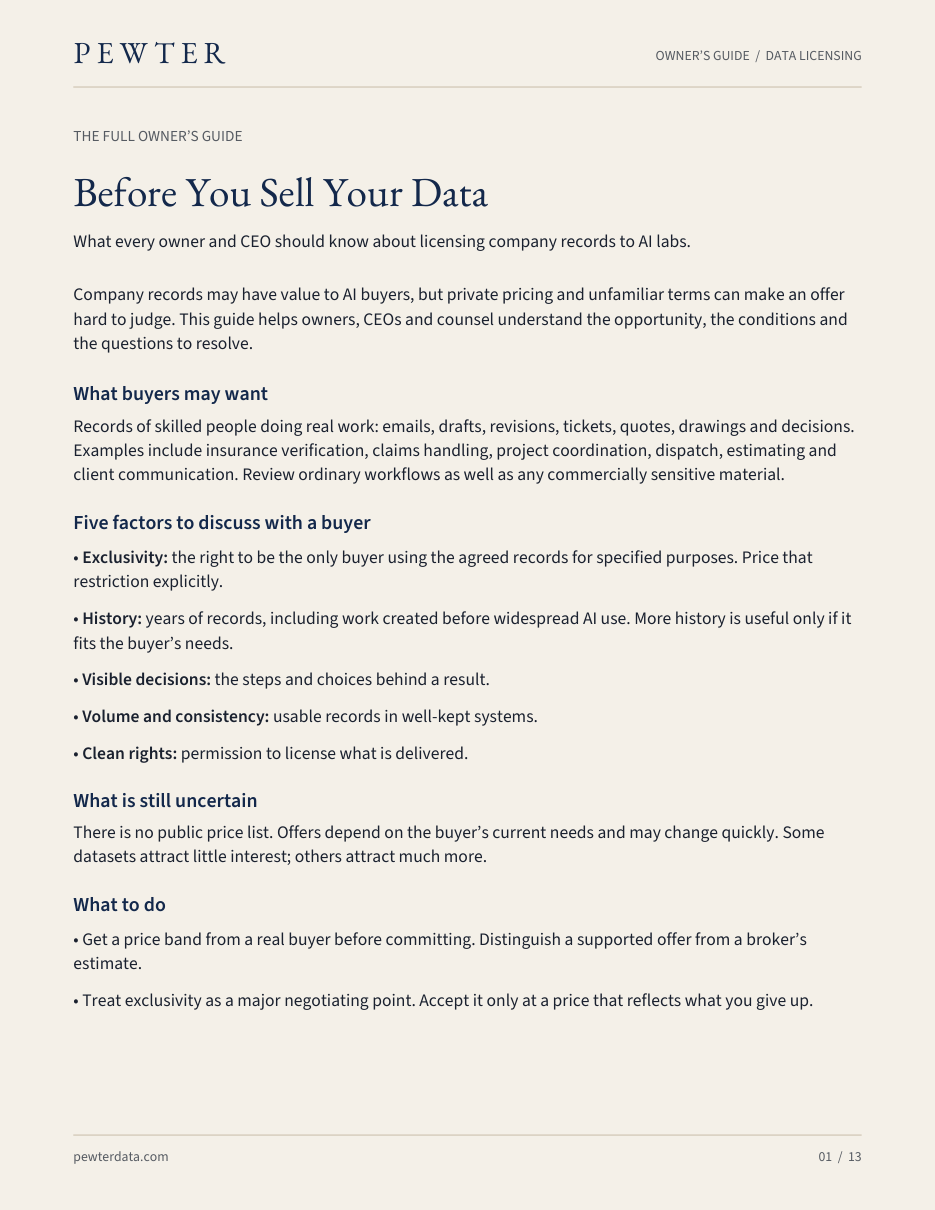
Before You Sell Your Data
What every owner and CEO should know about licensing company records to AI labs.
Company records may have value to AI buyers, but private pricing and unfamiliar terms can make an offer hard to judge. This guide helps owners, CEOs and counsel understand the opportunity, the conditions and the questions to resolve.
What is still uncertain
There is no public price list. Offers depend on the buyer’s current needs and may change quickly. Some datasets attract little interest; others attract much more.
What to do
Get a price band from a real buyer before committing. Distinguish a supported offer from a broker’s estimate.
Treat exclusivity as a major negotiating point. Accept it only at a price that reflects what you give up.
01 / Rights
What you own versus what you only hold
Having records on your servers does not automatically give you the right to license them.
What is still uncertain
Older client contracts may not mention AI training. Broad confidentiality terms can still restrict it. Do not assume removing identities also removes a client’s confidentiality rights.
What to do
Have counsel review your main client agreements, NDAs and standard terms before sharing a sample.
Check whether each system permits export for the intended purpose.
Exclude material you cannot clear. A smaller, clearly permitted dataset can be easier to transact than a larger disputed one.
02 / Privacy
Protect the people in the records.
Applicable rules depend on the records, the parties, the use and the jurisdictions involved.
Removing names and emails is not enough by itself. Job titles, dates, locations and writing style can still identify someone. Use separate firms to de-identify the records and independently assess the result.
What is still uncertain
There is no single universal test that clears every email or chat dataset for every use. A new AI-training use also needs review against the original collection purpose and notices.
What to do
Map the applicable rules before scoping the sale. Leave out higher-risk categories for a first deal.
Use a de-identification provider and a separate independent reviewer.
Honor existing privacy promises to employees and customers.
03 / Copyright
Sell rights a buyer can rely on.
A useful dataset needs a defensible license, not just a folder of files.
What is still uncertain
The ROSS ruling did not resolve the wider questions about generative AI. These cases do not mean every training use requires a license, or that every company archive is valuable.
What to do
Identify your original work separately from material owned by clients or third parties.
Check purchased reports, stock images and client deliverables before including them.
Expect the buyer to ask you to promise that you can grant the license. Promise only what you have checked.
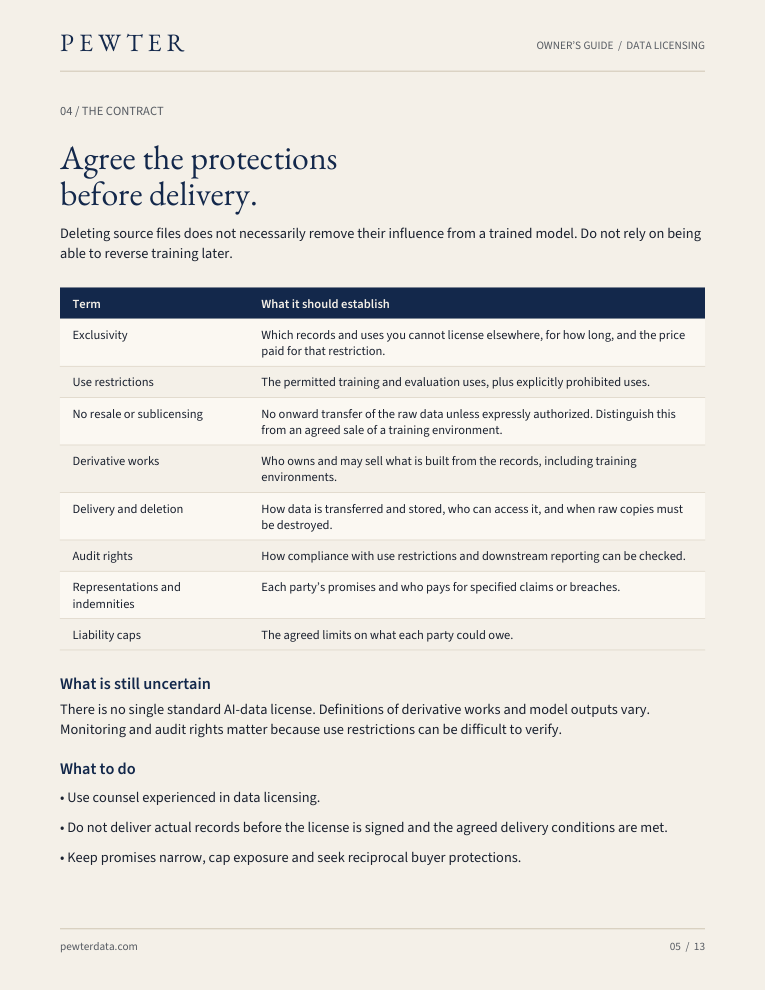
04 / The contract
Agree the protections before delivery.
Deleting source files does not necessarily remove their influence from a trained model. Do not rely on being able to reverse training later.
What is still uncertain
There is no single standard AI-data license. Definitions of derivative works and model outputs vary. Monitoring and audit rights matter because use restrictions can be difficult to verify.
What to do
Use counsel experienced in data licensing.
Do not deliver actual records before the license is signed and the agreed delivery conditions are met.
Keep promises narrow, cap exposure and seek reciprocal buyer protections.
05 / Insurance
Check coverage before extraction.
Do not assume your existing policies cover a deliberate license of data to an AI buyer.
What is still uncertain
Wording, exclusions and pricing are evolving. Different brokers may assess the same risk differently. A policy name is not confirmation that a claim is covered.
What to do
Ask your broker to assess cyber, E&O and D&O cover against the actual license. Get the assessment in writing.
Put the required coverage in place before extraction starts.
Align the policy with the contract’s promises and indemnities. Identify exclusions, limits, deductibles and any uninsured exposure.
06 / Getting paid
Negotiate both the first fee and the future upside.
If a buyer builds a product from your records, the commercial discussion should cover that downstream sale too.
What is still uncertain
Private pricing makes comparisons difficult. Bundled products can make it hard to attribute revenue to your records. Tax treatment depends on how the arrangement is structured.
What to do
Ask whether the buyer will resell what it builds. Put your revenue share in writing.
Require downstream reporting and audit rights covering bundles, renewals and products derived from your data. Specify that the buyer pays audit costs if an underpayment is found.
Agree a downstream-sale deadline or minimum payment, and what happens if the buyer misses it.
Ask your CPA to review the structure before you sign.
07 / Internal approval
Get the right people involved early.
A deal can stall inside your company when a risk appears without a clear answer or owner.
What is still uncertain
There is no universal communications playbook. A lawful deal can still concern employees, clients or the public.
What to do
Involve general counsel while the deal is being shaped, rather than only at final approval.
Use the headline test: could you explain the deal publicly in two clear sentences and stand behind it?
Name one internal owner from the first call to final payment.
08 / Specialist responsibilities
Give each step a named owner.
The role, deliverable and responsibility should be explicit in the contracts. Hiring a specialist does not automatically transfer all legal liability.
What to do
Name the responsible party for every step before records move.
Agree the scope, responsibilities and delivery conditions before execution begins.
Require full transparency: every party sees every other party’s share.
11 / Working with Pewter
One partner to coordinate the whole deal.
For enterprise organizations with 1,000+ employees, Pewter designed a coordinated system to speed up enterprise data deals.
Pewter brings legal, insurance, security, privacy and engineering specialists into one coordinated process. Clear responsibilities and aligned handoffs are designed to reduce delays and move enterprise deals forward faster.
12 / The enterprise partner system
Faster enterprise deals.
For organizations with 1,000+ employees. Pewter designed this system to coordinate specialists, reduce delays and speed up enterprise data deals.
There is no public price list and no standard AI-data license. Training can't be undone once records are delivered, so the rights, protections and payment terms have to be agreed first. The guide sets out what to ask, and of whom.
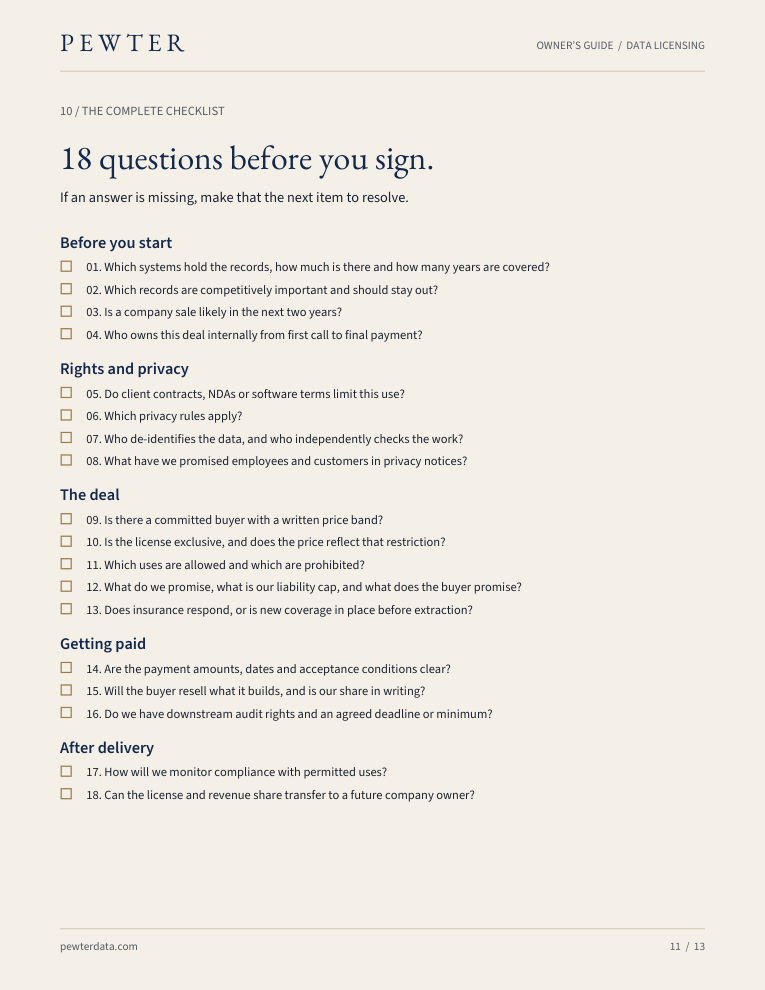
The 18-question checklist. Any blank answer is your next item to resolve.Eight contract terms to agree before delivery, from exclusivity to liability caps.
Still working out what records you have? Our other free guide, What is your company's data worth?, shows where the numbers live in Google, Microsoft 365, Slack and a dozen other tools.
 Pewter