AI labs are paying established companies six figures for de-identified copies of their email, chat, files and operating records. This guide shows what drives the price and how to size your own data before you talk to any buyer.
What has actually been paid, from court filings, press and licensing firms
The five things buyers price on, and why internal communications anchor every deal
Where the numbers live in 15 tools: Google, Microsoft 365, Slack, Salesforce, QuickBooks and more
A prompt for sizing everything with your own AI agent, safely
A one-page inventory worksheet and how to compare offers
13 pages · PDF · Written for US companies with 20+ employees and 3+ years of records.
Next step: put your headcount and years in business into the Pewter calculator for a first range. It takes about a minute.
Read the guide
What the guide covers
The main points of each section are below. The full guide adds the step-by-step instructions for each system, the worksheets and the tables.
I.
Why AI labs pay for ordinary business records
AI labs are teaching their models to do real work: answer a customer, quote a freight lane, reconcile an account, run a project. To train for that, they build practice environments that copy how real companies operate.
The raw material is the record of a real company doing its job, over years, across the tools it actually uses. That record is expensive for a lab to fake. Made-up data misses the messy parts: the exception, the back-and-forth, the fix. So labs pay companies that have the real thing, and they pay more for records that show complete work from start to finish.
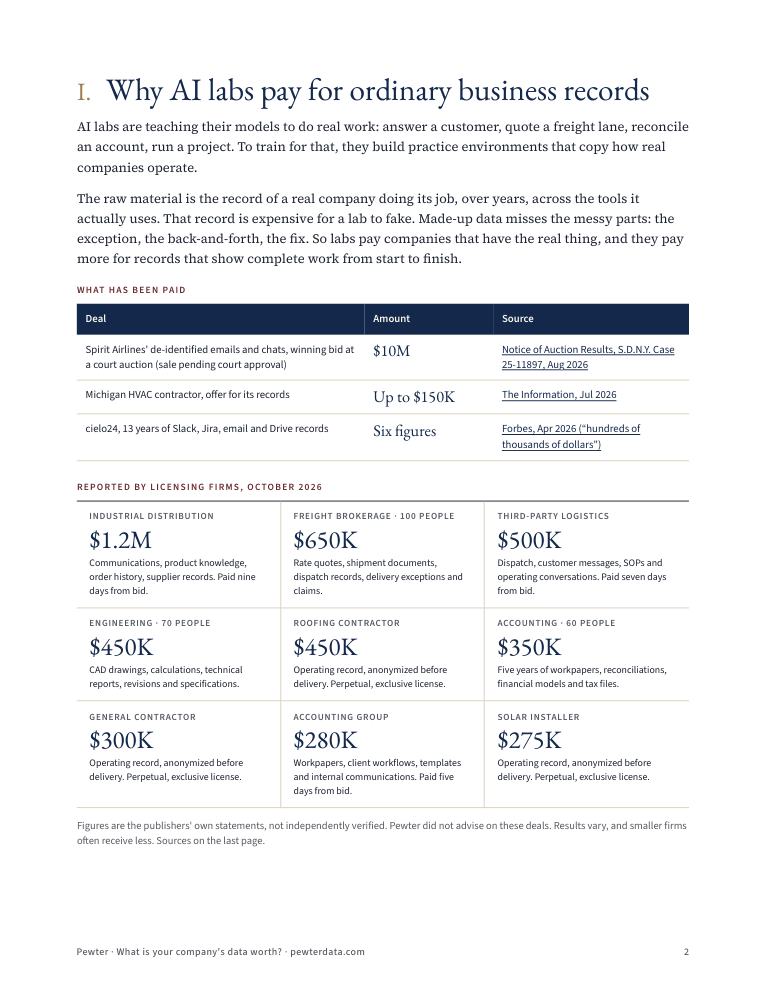
What has been paid
Spirit Airlines' de-identified emails and chats, winning bid at a court auction (sale pending court approval) · $10M · Notice of Auction Results, S.D.N.Y. Case 25-11897, Aug 2026
Michigan HVAC contractor, offer for its records · Up to $150K · The Information, Jul 2026
cielo24, 13 years of Slack, Jira, email and Drive records · Six figures · Forbes, Apr 2026 (“hundreds of thousands of dollars”)
Reported by licensing firms, October 2026
Industrial distribution · $1.2M · Communications, product knowledge, order history, supplier records. Paid nine days from bid.
Freight brokerage · 100 people · $650K · Rate quotes, shipment documents, dispatch records, delivery exceptions and claims.
Third-party logistics · $500K · Dispatch, customer messages, SOPs and operating conversations. Paid seven days from bid.
Engineering · 70 people · $450K · CAD drawings, calculations, technical reports, revisions and specifications.
Accounting · 60 people · $350K · Five years of workpapers, reconciliations, financial models and tax files.
General contractor · $300K · Operating record, anonymized before delivery. Perpetual, exclusive license.
Accounting group · $280K · Workpapers, client workflows, templates and internal communications. Paid five days from bid.
Solar installer · $275K · Operating record, anonymized before delivery. Perpetual, exclusive license.
Figures are the publishers' own statements, not independently verified. Pewter did not advise on these deals. Results vary, and smaller firms often receive less.
II.
What buyers actually price on
Two companies with the same amount of data can get very different offers. Five things drive the number.
1. The mix, not just the size
Total storage alone tells a buyer very little. 2 TB that is mostly video backups prices very differently from 2 TB of email, chat and operating records. You need the breakdown by system, not one big number.
2. Internal communications are the anchor
Slack, Microsoft Teams and internal email show how decisions actually get made. They tie everything else together. A deal without internal communications is a weak deal.
3. Depth
Years of history on the same systems. Five years of one CRM is worth more than five CRMs with a year each.
4. Thoroughness
Records that connect. The email about the order, the order in your ERP, the invoice in accounting, the ticket when something went wrong. Complete threads beat scattered fragments.
5. Accuracy
Buyers bid on the numbers you give them. If those numbers fall apart when they look closer, the bid gets pulled. Measure, don't guess. The rest of this guide shows you how.
III.
Two ways to get your numbers
Option A: admin panels (fastest)
Almost every business system has an admin screen that shows totals: storage used, number of users, number of records. Whoever holds admin access opens it and writes the numbers down. For most companies this takes a few minutes per system. The next section shows where the numbers live in the most common tools.
Option B: your own AI agent (for data spread across many tools)
If your records sit in a dozen places, you can have an AI agent you control walk your systems and total them up. Section V has the setup rules and a prompt you can copy.
The one rule for this stage
You only need counts. Don't export, copy, download or send any data while you size it. Nothing leaves your systems until there is a signed agreement and the data has been de-identified.
Nobody, Pewter included, needs your passwords or access to your systems to give you an offer.
IV.
Where the numbers live, system by system
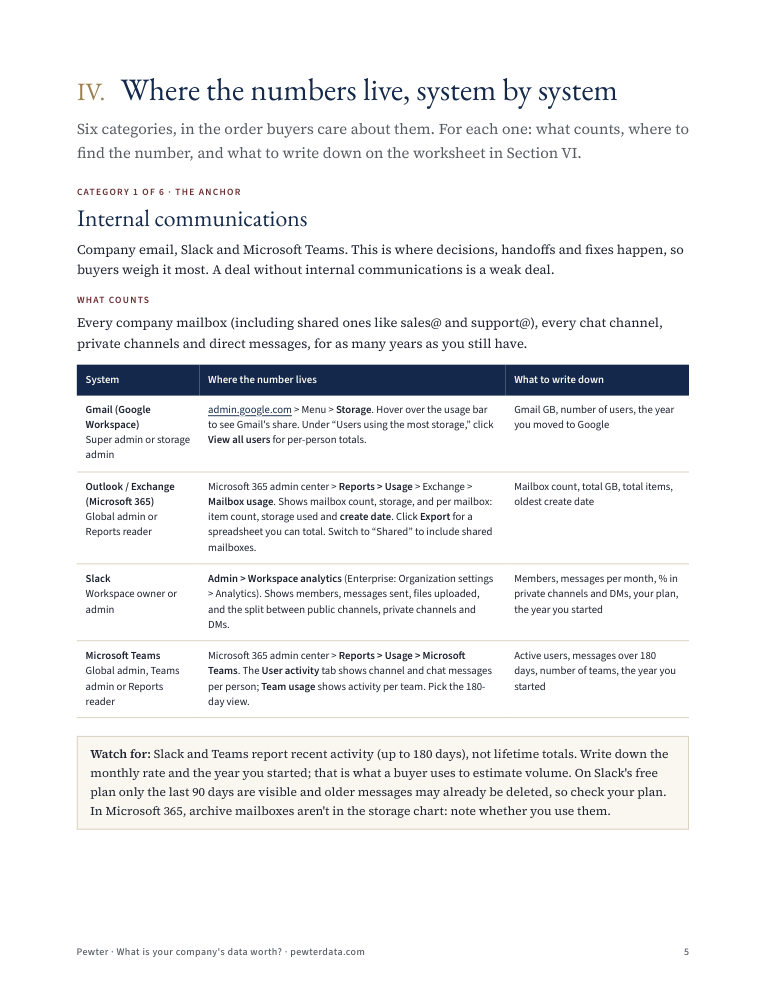
Six categories, in the order buyers care about them. For each one: what counts, where to find the number, and what to write down on the worksheet in Section VI.
Category 1 of 6 · The anchor
Internal communications
Company email, Slack and Microsoft Teams. This is where decisions, handoffs and fixes happen, so buyers weigh it most. A deal without internal communications is a weak deal.
Category 2 of 6
File storage
Google Drive, OneDrive, SharePoint, Dropbox and Box. Decks, documents, spreadsheets and PDFs show the finished work behind every conversation.
Category 3 of 6
Knowledge bases
Notion, Confluence, internal wikis and SOPs. They show how your company says the work should be done, which pairs with the record of how it was actually done.
Category 4 of 6
Operating systems
ERP, WMS, MRP, CRM, accounting, ticketing and project management. These hold the structured record of the work: every order, job, ticket and transaction, with dates.
Category 5 of 6
Commerce and transactions
Shopify, order history, invoices, fulfillment records, vendor and supplier data. Transactions tie the conversations to real money and real outcomes.
Category 6 of 6
Work product
Presentations, proposals, reports, client deliverables and design files. This is usually already inside your file storage; the point here is to call it out so a buyer sees it.
V.
Doing it with your own AI agent
An AI agent can save hours when your data is spread across many tools. It can also do damage if you hand it more access than it needs. Run it yourself, inside your own accounts, under these rules.
Security rules
You run it, in your own account. Don't give an outside person or company access to your systems to do this for you.
Read-only access only. If a tool asks for permission to edit, send or delete, say no.
Counts, not contents. Point it at admin reports and storage totals. It should never open, read or summarize individual emails, messages or files.
Turn access off when you're done. Disconnect the agent and revoke any tokens you created for it.
Keep the output to numbers. If anything comes back with customer names or message text, delete it before you share the results.
VII.
What happens after the inventory
You share the numbers. The completed worksheet. Counts and totals only, no data.
We confirm them with you. A short call to check the mix, the years and anything that looks off.
Sample and de-identification (larger deals). A buyer may ask for a small sample first. It is de-identified before it leaves your hands (names, emails, phone and account numbers removed or replaced), then reviewed by the buyer or an independent third party.
You get a written offer. Price, license terms, delivery and payment timing, in writing, before you commit to anything.
Delivery and payment. The full dataset is de-identified and delivered under the agreement. Several published deals were paid within days of the bid.
VIII.
How to compare offers
Talking to more than one buyer? Compare the terms, not just the headline number.
IX.
Sharing this with a business owner?
If you advise business owners as an accountant, attorney, broker, consultant or IT provider, this guide is the easiest way to explain the opportunity. Good fits are US companies with 20+ people and 3+ years of records, whether they're operating, downsizing or winding down.
Pewter's partner program pays 10% of what the business is paid, up to $100,000 per business, once the deal closes. A $650,000 deal earns the introducing partner $65,000.
Buyers bid on the numbers you give them. If those numbers fall apart later, the bid gets pulled. The guide walks you through measuring each system from its admin screen, without exporting or sending anything.
Published deals, with every figure sourced.Where the numbers live, tool by tool, checked against each vendor's help pages.
 Pewter